with the internationalization of business, more and more companies are deploying vps in cambodia to reduce delays and compliance risks. this article focuses on how enterprise-level applications can use vps cambodia to achieve high availability and disaster recovery. it provides practical suggestions from architecture, data strategy to operation and maintenance drills, and is suitable for reference by operation and maintenance and architects.
when deploying vps in cambodia, it is necessary to clarify the availability objective (sla), recovery time objective (rto) and recovery point objective (rpo). combined with business priorities and compliance requirements, determine which services require localization, multi-active or off-site backup, thereby determining the overall strategy and cost rationality of high availability and disaster recovery.
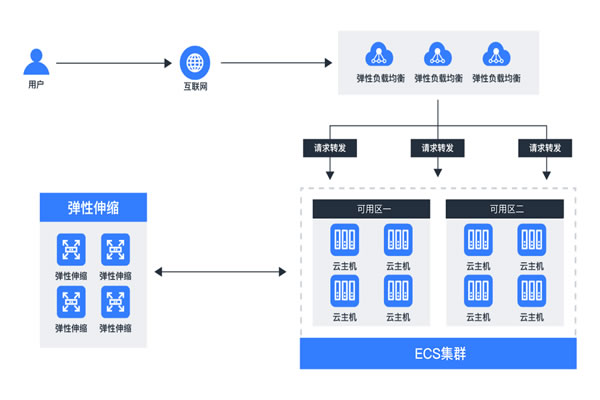
use multi-node distributed deployment and try to distribute instances in different computer rooms or availability zones to avoid single points of failure. for critical services, it is recommended to use active-active or active-passive topology, combined with status synchronization or shared storage, to ensure automatic switching and maintain business continuity in the event of a single point failure.
introduce a load balancer into the vps cambodia environment to achieve traffic distribution and health checking. for stateful applications, choose session stickiness or external session storage (such as distributed cache) to ensure user experience; at the same time, configure health probes to achieve automatic elimination and recovery of faulty instances.
database and file data should be replicated synchronously or asynchronously in combination with rto/rpo selection. synchronous replication is suitable for strict consistency scenarios but is sensitive to latency; asynchronous replication is suitable for cross-region replication to reduce latency and ensure backup integrity, in conjunction with regular consistency verification and snapshot strategies.
develop a multi-level backup strategy, including frequent incremental backups and regular full snapshots, and clarify backup retention periods and encrypted storage requirements. automate the backup process and verify recovery feasibility to ensure that business data and configuration can be restored within a specified time at any failure point.
combined with health checks to achieve automatic failover, use smart dns or global load balancing to achieve traffic transfer. ttl settings need to balance the switching speed and the impact of dns cache, and cooperate with monitoring alarms and scripted drills to ensure that the switching process is controllable and reduce user interruption time.
establish a monitoring system covering hosts, networks, applications and business indicators, set up multi-level alarms and connect them to the automated repair process. log centralization and tracking can speed up fault location, and long-term indicator analysis is used for capacity planning and preventive maintenance to improve overall availability.

high availability and disaster recovery design cannot ignore security at the same time. network segmentation, least privilege access, transmission and storage encryption, and intrusion detection should be implemented. for regional deployment in cambodia, pay attention to local laws and industry compliance requirements to ensure that disaster recovery data and access policies meet compliance audits.
regularly perform disaster recovery drills to verify rto/rpo. the drills should cover single point failure, computer room failure and cross-region network interruption scenarios. at the same time, infrastructure as code and automated deployment are promoted to reduce manual intervention time and ensure fast and predictable service restoration when real failures occur.
for cross-regional services, link quality should be evaluated and a reasonable traffic routing strategy should be selected. use cdn, edge caching and connection pool technologies to reduce delays; perform stress testing and optimization on critical paths to ensure that service availability and response speed can be maintained under high concurrency or network jitter conditions.
the high availability and disaster recovery solution for deploying enterprise-level applications in vps cambodia should be oriented towards business goals and integrate elements such as architectural redundancy, data replication, backup strategies, monitoring and drills. it is recommended to first define a clear rto/rpo and gradually implement it in phases, from basic redundancy to automated drills, and continuously optimize to balance cost and availability.
- Latest articles
- A Practical Guide Teaches You Common Testing Methods To Verify Whether Hong Kong Server Clusters Are Exclusive
- Contract Considerations: Caution Is Needed When Choosing Ranked Vendors For US Server Rentals
- Best Practices For SMEs Using Cambodia CN2 Return-to-China Servers To Reduce Latency Costs
- Common Troubleshooting Steps And Rapid Recovery Solutions For Taiwan Telecom CN2 Broadband
- An Automated Operations And Maintenance Solution Covering Everything From Development To Monitoring How To Build A Site On Hong Kong Cloud Servers
- From A Business Perspective, Is Vietnam's VPS Reliable? Considerations Regarding Compliance And Data Security
- Free Server Korea Security Protection Policy And Backup Implementation Guide
- Cost And Operation Management Recommendations For Enterprises Deploying Korean CN2 Site Cluster Cloud Servers
- Basic Information On Taiwan Proxy Servers, Common Terminology Explanations, And Purchase Precautions
- How To Choose A Cloud Server In Thailand: From Network Latency To After-sales Service, Comprehensive Aspects
- Popular tags
-

Characteristics And Applicable Groups Of VPS Registration-free Service In Cambodia
Understand the characteristics and applicable groups of Cambodia's VPS registration-free service, and help you choose the right virtual dedicated server. -
Practical Deployment Manual For Using Tencent Cambodia Cloud Server From Scratch
a practical deployment manual for using tencent cambodia cloud server from scratch, covering account preparation, network planning, instance and image selection, security configuration, backup and monitoring, and cost optimization suggestions. it is intended for technicians who need to deploy cloud services in cambodia. -

Analysis Of The Implementation Scenarios Of Cloud Server Cambodia In Cross-border Payment And E-commerce
this article analyzes the implementation scenarios of cloud servers for cross-border payment and e-commerce in cambodia from the perspectives of technology, compliance, network and operation and maintenance, and provides architectural key points, performance optimization and implementation suggestions, which are suitable for enterprises and technical decision-makers.